If you’ve ever worked with inductors—whether you’re an electrical engineer designing power supplies, a hobbyist tinkering with a DIY amp, or someone who just wants their circuit to work without overheating—you’ve probably heard the term “skin effect” thrown around. And if you’re buying inductors, it’s not just a buzzword: it’s something that directly affects how your parts perform, cost, and hold up over time. Let’s break this down like we’re chatting over a bench at a trade show, no stuffy textbook jargon, just the real stuff from a supplier that’s seen every weird inductor problem under the sun. Inductor
First, let’s start with the basics you might already know, to set the stage. When current flows through a wire, right? For DC (direct current), that current spreads evenly across the whole cross-section of the wire. Picture a garden hose full of water: the flow is the same at the center as it is near the walls. That’s straightforward. But AC (alternating current) is totally different, and that’s where skin effect rears its head.
Here’s the simple version: when AC flows through a conductor, the magnetic field it creates around the wire isn’t static. It’s flipping direction as the current alternates, which induces eddy currents inside the wire itself. Those eddy currents push the main AC current away from the center of the wire and force it to flow only in a thin, outer layer—called the “skin”—of the conductor. The higher the frequency of the AC, the thinner that skin gets. For example, at 60Hz (standard mains power in North America), the skin depth (that thin layer) is around 8.5mm for copper. At 10kHz, it drops to just over 0.2mm, and at 1MHz, it’s less than 0.07mm. That’s super thin—most of the wire’s inside is just wasted space for high-frequency AC.
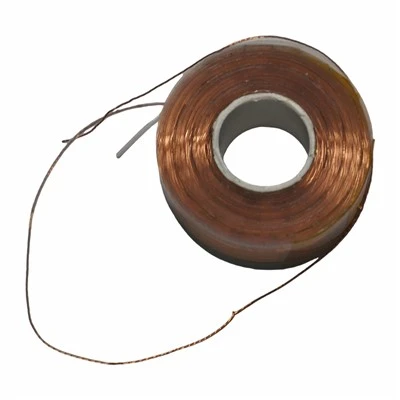
Now, why does this matter for inductors specifically, not just random wires? Let’s remember what an inductor is: it’s usually a coil of wire, right? More turns mean more inductance, which is what you want for filtering, energy storage, or noise suppression. If you’re winding that coil with solid round wire, skin effect turns that big, thick wire you bought into a tiny hollow tube. The effective cross-sectional area for current is way smaller than it looks on the spec sheet. That means two big problems for your inductor: higher resistance, and more heat.
Wait, resistance is R = ρL/A, right? (ρ is resistivity, L is wire length, A is cross-sectional area.) If A is effectively smaller because of skin effect, R goes up. More resistance means your inductor wastes power as heat—power that your circuit is supposed to be doing work with. That’s a huge deal for high-current, high-frequency apps, like switching power supplies, EV chargers, or RF circuits. If you’re running a 10A current at 100kHz through an inductor with solid wire, the skin effect could make the effective resistance 2-3x what it would be for DC. Suddenly, your part is overheating, your efficiency is dropping, and your circuit might be shutting down or failing early.
As an inductor supplier, we see this all the time when customers come to us saying, “My 10uH inductor is getting way too hot—what gives?” Nine times out of ten, it’s either solid wire at high frequency, or they didn’t account for skin effect when sizing their coil. A common mistake people make is thinking, “If I need 10A, I’ll just grab a 2mm copper wire” without checking the skin depth at their operating frequency. That 2mm wire has a skin depth of ~0.2mm at 10kHz, so only the outer 0.2mm is carrying current. The actual copper that’s doing work is a tiny ring around the center—like using a soda can instead of a solid pipe. It’s not surprising it’s overheating.
So what’s the fix? This is where we come in, because we don’t just sell inductors—we solve these problems. The most common solution for skin effect in inductors is Litz wire. What’s Litz wire? It’s not just one thick wire—it’s hundreds of tiny, insulated strands twisted together. Each strand is thin enough that the skin depth at your operating frequency is bigger than the strand itself, so the current can spread across every single strand, no pushing to the outside. Wait, and they’re twisted so no strand stays on the outside of the coil all the time, right? That prevents another effect called proximity effect, which is like skin effect but between adjacent turns of the coil—we’ll save that for another day, but Litz wire kills two birds with one stone for high-frequency inductors.
But Litz wire isn’t perfect. It’s more expensive than solid wire, harder to wind neatly, and if the insulation between strands is damaged, you get hot spots and failures. That’s why as a supplier, we don’t just slap Litz wire on every order. We first work with you to figure out your operating frequency, current, and efficiency requirements. If you’re running low-frequency (like 50/60Hz mains), skin effect is almost negligible—solid wire works fine, no need to pay extra for Litz. But if you’re above 1kHz, especially 10kHz and up, we run the numbers to calculate the skin depth, pick the right wire type, and even adjust the coil winding pattern to minimize the impact.
Another thing we’ve noticed: a lot of people mix up skin effect with other inductor losses, so let’s clear that up. Inductor losses are usually split into two types: core loss (from the magnetic core the coil is wrapped around) and copper loss (from the wire itself). Skin effect is a big part of copper loss, especially at high frequencies. Core loss comes from the core material getting magnetized and demagnetized fast—like how a metal spoon gets hot if you rub a magnet on it over and over. So when a customer says, “My inductor is hot,” we test both: first check if it’s copper loss (pull the coil off the core and test it) or core loss. Skin effect is the main copper loss culprit for high-frequency parts, so that’s our go-to when the issue is wire-related.
Wait, let’s use a real example we had last year to make this concrete. A customer was designing a 48V to 12V DC-DC converter for a drone, running at 50kHz, needing 5A continuous current. They ordered 100 inductors with solid 1.5mm copper wire. First batch came back 12% less efficient than their simulation said it should be, and parts were failing after 20 hours of testing due to overheating. We ran the skin depth calculation: at 50kHz, copper’s skin depth is ~0.09mm. So that 1.5mm solid wire only has a cross-sectional area of a ring with outer radius 0.75mm and inner radius 0.75 – 0.09 = 0.66mm. That’s a usable area of ~0.044 mm², instead of the full ~1.77 mm² for the solid wire. The effective resistance was 4x what their simulation used for copper loss—hence the overheating. We swapped them to a Litz wire with 40 strands of 0.1mm wire, each strand’s diameter way smaller than the 0.09mm skin depth at 50kHz. The efficiency jumped to 96% from 88%, no more overheating, and the parts passed 100-hour stress tests. That’s exactly why understanding skin effect matters: it’s not just a physics trick, it’s what makes your product work.
Another myth we hear all the time: “Skin effect only happens at really high frequencies, like MHz.” No, it’s frequency-dependent, but even 1kHz is enough to see a difference. Let’s do quick math: at 1kHz, copper’s skin depth is ~2.06mm. So a 3mm solid wire would have a usable cross-section of a ring with outer 1.5mm, inner 1.5 – 2.06 = negative? Wait, that means the whole wire is larger than skin depth, so current spreads almost evenly. But a 1mm solid wire at 1kHz: skin depth is 2.06mm, so the whole wire is smaller than skin depth, no skin effect. So the cutoff is when the wire’s diameter is roughly twice the skin depth. If your wire is thicker than that, skin effect starts to hit. That’s a simple rule of thumb we use with customers to give quick, no-BS advice before they even send specs.
What about for power inductors vs. signal inductors? Signal inductors are usually small, low-current, high-frequency (like in radio circuits), so skin effect is a huge factor there—every stray resistance matters for signal quality. Power inductors are higher current, so if you undersize the wire due to not accounting for skin effect, you get heat and efficiency loss, which translates directly to higher energy bills for your product, or even component failure. As a supplier, we tailor our recommendations to your use case: signal parts get optimized for minimal copper loss from skin effect, power parts get sized to keep both core and copper loss (including skin effect) balanced, so your inductor is as efficient as possible without being unnecessarily expensive.
We’ve also run into weird edge cases: customers using inductors in harsh environments, like industrial motor drives running at 20kHz, or medical devices with sensitive electronics. In those cases, not only do you need to mitigate skin effect for efficiency, but you also need to make sure the coil winding is durable. Litz wire’s stranded construction can be more prone to vibration damage if not properly potted, so we adjust the twist rate and add a coating or potting material that locks the strands in place. We test these parts under load and vibration to make sure the skin effect doesn’t come back after a few months of use—something that big suppliers might skip, but we know how important reliability is for your end product.
Now, let’s talk about what you should do if you’re dealing with skin effect issues, or just want to make sure your next inductor order is right. First, don’t guess on frequency. Most people have a rough idea, but if you’re not sure, tell us the operating frequency of your circuit, the current (AC and DC, if both are present), and your efficiency or temperature requirements. We’ll run a quick skin depth calculation, tell you if solid wire works or if Litz is needed, and even offer a sample to test before you place a full order. A lot of customers wait until their first batch fails, which costs time and money—we can avoid that upfront by just sharing the numbers.
Another tip: if you’re designing a custom inductor, don’t just pick the lowest cost option. Solid wire is cheap, but if skin effect makes your part 10% less efficient, you’ll end up paying that extra cost over the life of your product in energy waste. We price Litz wire fairly, and for most high-frequency apps, the efficiency gain pays for itself in a matter of months.
Wait, let’s wrap this up without getting too salesy, but make it clear that we’re here to help. Skin effect isn’t some abstract physics concept—it’s a real, solvable problem that impacts your inductor’s performance, reliability, and cost. As an inductor supplier, we don’t just provide parts; we leverage our hands-on experience with hundreds of projects to cut through the jargon and give you advice that works for your specific needs, not a one-size-fits-all spec sheet.
If you’re currently dealing with overheating inductors, efficiency drops, or just want to design a better circuit, we can walk through your requirements, calculate the impact of skin effect on your design, and source or build the perfect inductor for you. Don’t let hidden effects like this derail your product—reach out, and let’s solve this together.
Low-voltage Transformer References
- Electromagnetic Theory for Engineers, J.D. Kraus, McGraw-Hill
- Inductor Design Handbook, W.G. Hurley and W.H. Wölfle, John Wiley & Sons
- “Skin Effect and AC Resistance of Round Conductors”, N. Takahashi, IEEE Transactions on Power Electronics, 2005
- Litz Wire Application Guide, The Wire Association International, 2018
Dongguan Hensiron Electric Co., Ltd.
As one of the most professional inductor suppliers in China, we have world-leading production equipment and strong manufacturing capabilities. Please feel free to buy high quality inductor made in China here from our factory. Customized orders are welcome.
Address: Building 4, Xinxing Industrial Zone, Wangao Road, Wanjiang Street, Dongguan City, China
E-mail: jessica@dghensiron.com
WebSite: https://www.dghensiron.com/
